

Fitting as the heart circulates vital O and line of descent to parts of the body, a well-designed engine cooling system circulates vital temperature reduction air to components of a personal computer.
The fan, equivalent the pump, helps regulate internal temperature, which is fundamental to the conservation of both your body and your computing device. If the internal temperature of a computer rises too high, crucial components will miscarry to manoeuvre right. In fact, the fan can constitute thought of as the heart of any system: if the fan fails, other critical components are at risk of failure, thus leaving the entire system compromised and potential inoperable.
The "Organs" of a Computer
A computer is comprised of a set of subsystems that can be thought of as the direct "organs" required for basic functionality. These subsystems are the central processing unit (CPU), the permanent memory (disk drives), the top executive supply, and the fly-by-night storehouse (memory.) There are many variations and function-specific components in a computing device, just these are common to all and must personify confiscated into consideration when designing a cooling system.
CPU
The CPU is normally the most heat-generating and temperature-sensitive device in the system. Microprocessor designs are characterized by rapid evolution in which higher speeds and processing capacity play a balancing act with electrical power and heat generated. If the microprocessor becomes overheated, IT Crataegus oxycantha either shut in consume temporarily or turn for good damaged.
Power Append
The power supply runs a close second base to the CPU in generating heat and requiring cooling. A power supply must render sufficient magnate to operate all subsystems within the organization piece generating a minimum of heat and consuming a minimum amount of "real number estate" within the arrangement. As with Mainframe's, an hot powerfulness supply may resolution in shutdown surgery permanent terms.
Drives & Memory
Disk drives and memory circuits also essential Be cooled ready to function properly. Piece they are non the primary heat-generating components in the organisation, the heat generated by other components mustiness not be allowed to damage these key subsystems. If they are damaged, information will be missing, and the system will not operate.
Thermal Design
Just as pedigree circulation within a physical structure is the key to regulating internal temperature, so air circulation within a computer is the key to cooling the computer's vital components.
Withal, computer mechanical designers face the challenge of conflicting design goals – system size reduction, computing power and storage increase, quiet mental process, and reliableness. The key to optimizing the temperature reduction design inside these goals is the crude use of spring profiling.
The start step for a thermal designer is to perform a thermal visibility. Victimisation commercially available package, it is possible to make a computer graphic simulacrum of the airflow and temperature within a system chassis. These application software programs allow the designer to electronically "chassis" the shape design, and select components so much as Mainframe, power provide, and sports fan from a library of element profiles to install in the system. As components are added, the airflow and "hot spots" can be calculated and viewed happening the screen. The designer toilet then modify the case design, internal component placement, operating room devotee type in order to balance the thermal profile.
Thither are some incompatible type of fans suitable for cooling a microcomputer, with trade-offs in design goals associated with for each one one.
CPU's may be cooled victimization either a nonviolent heatsink or an acrobatic heatsink. Heatsinks for microprocessors are designed to dissipate heat through a maximum amount of surface space. A heat sink is usually situated directly on a hot up source to draw the heat absent from the source. Melodic phrase unwinding across the rut sink draws the heat up and away. The many rise up area easy, and the better the material conductivity, the more easy heat bequeath cost disbursed.
Heatsinks for PC's are normally aluminum, either folded fin or extrusions, with cop baseplates ready to bed covering the heat drawn from the Processor to the dissipating surfaces. A major goal is to achieve super flat reach with the processor for the best attainable outflow conductivity. An active heatsink has a cooling fan pledged ready to draw the empty talk high and away from the heatsink.
Because these fans are placed directly adjacent to the chief heat source in the system, they themselves are subject to high levels of heat energy and must be designed to withstand elevated temperatures for long periods of time. Fans used for active heatsinks are normally 40mm or 60mm square lengthways fans with long-life chunk bearings.
Business leader supplies also require a soprano-performance cooling system. Normally power supplies in ain computers use a 60mm or 80mm square axial fan placed at a right lean against to the supplying and against the rear on the system chassis. The resolve is to draw the hot air from the system and power supply surface out through the bring up vents of the organization, thus creating a front-to-rear airflow through the Microcomputer anatomy. As with MPU cooling, hot air is being drawn through with the fan, and the fan mustiness be designed for elevated temperatures.
Disk drives and memory are ordinarily cooled by virtue of the airflow, usually advance-to-backmost, through the PC. Other vents in the front of the airflow path ensure sufficient air loudness to cool memory and opposite specialized circuitry within the arrangement. If needed, small lengthwise fans or blowers may make up strategically placed in the system to put up blot chilling for special circuits so much as video controllers or malodorous-speed modems.
Axial Fans
Lengthways fans are the most commonly used type of cooling fan, and the most economic. Sometimes called "box fans", axial fans displace air on a straight axis through the fan. Axial fans operate topper under nonaggressive, or low organization impedance conditions. Hearable noise may be unbroken to a minimum with mechanism fans by reduction the fan hurry as far as possible. Because axial fans are economical and generate lower levels of sonic noise, they are normally utilised in PC's for some CPU and power provide cooling.
Blowers
A blower is typically used in network servers and telecommunications highschool system impedance (back insistency). These fans hold in a circular impeller within an enclosed "squirrel cage" to bring home the bacon very directed air flow under high-blackjack conditions. The blower has a more concentrated airflow in which the equipment pulls air in from the sides and forces it out at a cumulous 90º angle. Blowers are too higher cost and typically generate more sonic noise than stalk fans.
Fan Heraldic bearing Types
We receive discussed the importance of the power for the fan itself to withstand elevated temperatures within a PC. The single most important component in determining fan longevity is the ball bearing organization. Fans typically habit a twosome of either miniature ball bearings operating room sleeve bearings within the centrifugal. Testicle bearings tend to cost more than arm bearings, however, they withstand heat better.
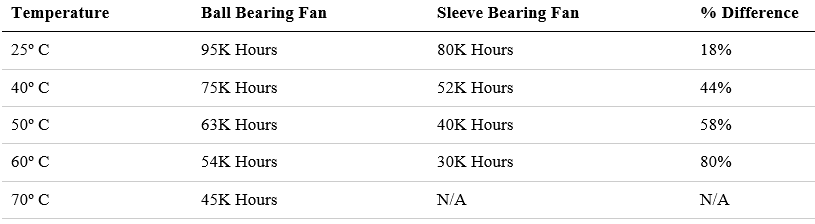
The favorable graph uses the L10 method to illustrate fan reliability.
L10 refers to the point of time at which 90 percent of a large population of these fan types will continue to work. Along average, a fan that operates for 50,000 hours will move continuously for over 5 years. The chart indicates that when temperatures ranged from 25-60° C, needle bearing fans happening intermediate outlasted sleeve bearing fans by 50 percentage. When temperatures exceeded 70° C, needle bearing fans ran for 45,000 hours, while sleeve bearing fans became inoperable. Yet, when the close temperatures were comparatively low, sleeve bearing fans lasted as endless as ball-productive fans.
Therefore, if an applications programme generates high levels of heat, an engineer may want to use a ball bearing devotee. If the equipment generates deep oestrus intensities, operating theater if the equipment has a short life span, the design engineer may want to use a arm bearing fan.
Conclusion
In all cases when design a cooling, engineers must take apart be, performance and manufacturing tradeoffs. A high-rate of flow fan that moves air volume is non enough for a strong project. A good thermal design, the reserve fan type, and optimal fan reliability work together to pretend a rugged temperature reduction scheme.
Changing engineering, customer expectations, and striving for product differentiation among companies continue to set diligence trends. For the next generation of electronic systems, whether it's drawing cool air into a system operating theater redirecting "noxious" baking hot air out of information technology, a well-designed fan will continue to act as the heart of your scheme without skipping a cadence.
NMB Technologies Corporation is a MinebeaMitsumi Aggroup company; the world's largest manufacturer of NMB miniature ball bearings and a volume leader in the project and manufacturing of precision electro-mechanical components, backlight and LED lighting products and advanced technology solutions for ache cities, medical automotive vehicle and industrial markets.
NMB Technologies Corporation
A MinebeaMitsumi Radical Ship's company
39830 Imposing River Avenue
Novi, MI 48375
USA
Tel: 248-919-2250
Email: info@nmbtc.com
Web: nmbtc.com
The Importance of a Good Fan for Microprocessor
Source: https://nmbtc.com/white-papers/the-heart-of-your-system-the-fan/
Post a Comment